Zum Inhalt wechseln

Skiing is more than just “going downhill”: it’s speed, technique, and that clear mountain feeling when the cold air burns and the snow works beneath you. Whether on the slopes, in the park, off-slope, or on a tour, you’ll learn to steer with your edges and weight, control your speed, and assess situations correctly. Find out more about the different disciplines, the basics of technique, equipment, and safety guidelines in this article.
Skiing in a nutshell
What skiing is all about
Skiing combines speed, technique, and experiencing nature. You glide over snow, steer using edges and weight shifts, and constantly adapt to the terrain, visibility, and surface. Added to this is the special feeling of speed, fresh air, and mountain panoramas.
What skiing disciplines are there?
Slope (Alpine)
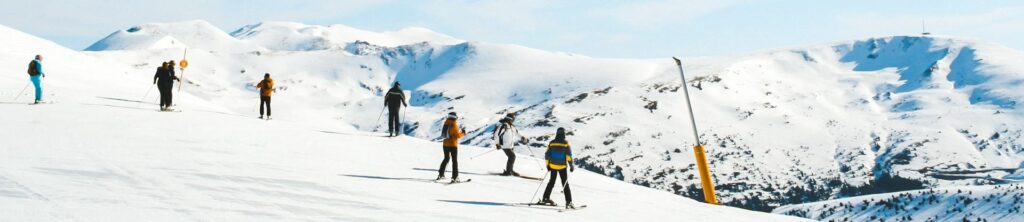
This is classic skiing on groomed slopes in a ski resort. This form is suitable for most people, especially beginners, because the conditions are more predictable (marked slopes, controlled terrain, mountain rescue, lifts).
Freeride
Skiing in open terrain away from the slopes and often in deep snow. It sounds like a powder dream, but it’s something to be taken seriously. This discipline is only for advanced or expert skiers, preferably with a guide and training. Important: Avalanche awareness, equipment, and experience play a major role here.
Touring (Skitour / Backcountry)
You climb uphill with skins under your skis and then ski back down, often away from the ski resort or at its edge. This type of skiing is suitable for people who want to experience the mountains “authentically”: more peaceful, athletic, and nature-oriented. Good uphill technique, downhill skills, and planning are required.
Park (Freestyle)
The park is the playful side of skiing. In the fun park, you will find kickers, boxes, rails, and various elements for jumps and tricks. Solid basic skills, coordination, and a good feel for speed and timing are required. Many people start out in the park with small waves or simple boxes and slowly work their way up, because falls are simply part of the game here.
Technical basics: For a controlled and relaxed experience
Basic stance
Your basic stance is your “home” on skis. You stand centered over your bindings and feel pressure on your entire foot, not just your heel. Your knees are slightly bent forward and remain soft so that they can cushion any bumps. Your upper body remains upright but not stiff. Your hands are in front and to the sides within your field of vision so that you remain stable and do not tip backwards.
The typical stages of learning
The snowplow is useful at the beginning because it gives you immediate confidence. You brake by bringing your skis together at the front and apart at the back and controlling the pressure. From the snowplow, you learn how to turn by putting more pressure on the outside ski and consciously making the turning radius smaller. The next step is the transition to parallel skiing, where the skis run increasingly evenly side by side and the turns are controlled by pressure on the ski edges. Braking is not an extra technique, but the result of a clean turn and controlled speed.
Control your speed instead of "going full throttle"
Control comes not from courage, but from technique. You control your speed by the curve path, not by force. It is better to take round, even curves and use the slope crosswise when you pick up speed. Start the curve early and finish it cleanly, then you will slow down without braking abruptly. If you become unsure, reduce your speed by taking more curves, not by frantically squeezing into a snowplow.
Common beginner mistakes
Many beginners are too stiff, which hinders their mobility. You need loose knees and flexible ankles so that your skis can grip the snow. Another classic mistake is leaning too far back, which makes the skis difficult to control. You will be more stable if you stay centered and feel the pressure on the front of your shin. Many people also look at their skis, which causes their posture to collapse and their line to deteriorate. You will ski better if you look where you want to go and keep your gaze a few meters ahead.
Safety & behavior on the slopes
The FIS rules in a nutshell
Be considerate: Ski in such a way that you do not endanger or obstruct anyone else.
2. Adjust your speed and riding style: Adjust to your ability, visibility, weather, snow conditions, and slope density.
3. Lane selection (coming from behind): If you are coming from behind, you must pass/swerve in such a way that it is safe for those in front.
4. Passing: You may pass above, below, left, or right—but always with sufficient distance.
5. Entering/starting/crossing: When starting or crossing: look up and down and only start when the way is clear.
6. Stopping: Do not stop in narrow places or where visibility is poor. If you fall: quickly move to the edge.
7. Ascending (on foot) only at the edge: When walking up or sideways: always at the edge of the slope, not in the middle of the descent.
8. Observe slope signs: Observe markings, barriers, warning signs, and notices at all times.
9. Provide assistance: In the event of an accident: stop, secure the area, and help (e.g., secure the accident site).
10. Obligation to provide identification in the event of an accident: In the event of an accident: provide personal details (for those involved and witnesses).
Assessing weather, visibility, and snow conditions
Poor visibility, wind, and changing light conditions make the slopes more dangerous than many people think. In fog, low light, or snowfall, you will notice bumps later and need to keep more distance. Watch out for hard or icy patches, especially in the morning or on busy sections. Fresh snow can create bumps and hidden edges, and in the afternoon the snow often becomes soft and heavy. Adjust your speed and route and ski defensively if you are unsure.
When to take a break
Fatigue is a major accident factor because it impairs reaction times, coordination, and concentration. If you notice that you are making more mistakes, riding less smoothly, or your legs are “giving way,” it is a good idea to take a break. Cold weather, dehydration, and hunger also impair your attention. Drink regularly, eat a snack, and warm up briefly before setting off again. The best time to take a break is not after you’ve almost fallen, but as soon as you notice that you are no longer fully focused.
Equipment: What really matters
Basics (Must-have)
The basic equipment includes skis, ski boots, and suitable bindings. If you are just starting out, it does not have to be the latest model, but it should be appropriate for your skill level and weight.
A helmet is standard nowadays and is practically mandatory in many ski resorts. You will also need ski goggles for visibility and protection, as well as warm gloves with good grip.
When it comes to clothing, function is more important than brand. The best approach is to dress in layers: a breathable base layer, a warm middle layer, and a windproof and waterproof outer layer.
Buying vs. borrowing
Renting is often the best choice if you are just starting out or only ski a few days a year. You save money, remain flexible, and can try out different ski models without committing yourself.
Buying is worthwhile if you ski regularly and want long-term comfort. Your own equipment feels more familiar, fits better, and can be cheaper over the years than constantly renting.
A good tip is to invest in ski boots first. The fit determines whether you stand stable, get clean pressure on the skis, and still enjoy skiing in the afternoon. Boots that are too big or too tight quickly cause pain, cold feet, and less control.
Small helpers that make a big difference
Protective gear is optional, but a back protector can be useful, especially at higher speeds, off-road, or if you feel unsure. Safety is not just a question of skill, but also of energy reserves.
The little things are often underestimated: sunscreen and lip balm should always be in your bag, because the sun and wind are stronger in the mountains. Hand warmers help on very cold days, and a small backpack with water and some provisions will keep you going for longer.
Recovery is also part of your equipment. If you drink enough, take short breaks, and stretch or move around gently in the evening, you will have less muscle soreness and more good days on the slopes in a row.
Zusammenfassung
Want to not just read about it, but experience it for yourself? Then grab your helmet, goggles, and good gloves and hit the slopes. Start with the basics and work your way up. Then look ahead, control your speed through the turns, and hit the snow.